Almost everyone knows their birthstone, but very few people know where the idea actually came from. It feels like something ancient and mystical, and in a way it is, but the list of gems most of us use today is younger than the light bulb. The story of birthstones stretches from a sacred breastplate described in the Bible, through centuries of confused and competing lists, all the way to a room full of American jewelers who sat down in 1912 and decided, once and for all, which stone belonged to which month.
Where Did Birthstones Originally Come From?
Birthstones trace back to a jeweled breastplate described in the Book of Exodus, worn by Aaron, the brother of Moses, more than 3,000 years ago. It had nothing to do with birthdays at first. It was a religious garment covered in twelve different gemstones, arranged in four rows of three, with each stone representing one of the twelve tribes of Israel.
The exact identity of those twelve stones is still debated by historians today, since the ancient Hebrew names for them do not translate neatly into modern gem names. Most scholars agree the list likely included stones like carnelian, peridot, emerald, garnet, lapis lazuli, amethyst, citrine, onyx, and jasper, though the order and exact composition vary between translations. What matters for the birthstone story is not the precise list, but the number: twelve stones, one for each of twelve important groups, laid the groundwork for a tradition that would eventually attach itself to the twelve months of the year.
The breastplate did more than represent the tribes visually. Tucked inside its folds was a separate element known as the Urim and Thummim, believed to have been used by the high priest to seek yes-or-no guidance from God on serious matters, such as whether to go to war. Their exact physical form is still debated by scholars, but the function attributed to them shows the breastplate was treated as a working tool for leadership decisions, not purely ceremonial jewelry, which helps explain why its twelve stones carried so much symbolic weight in the first place.
The breastplate was never intended as a personal accessory tied to someone’s birth month. That connection came centuries later, and it happened almost by accident.
How Did the Twelve Stones Become Connected to the Zodiac?
The link between the breastplate and birth months was first proposed by the first-century historian Flavius Josephus, who noticed that the twelve gems lined up neatly with the twelve months of the year and the twelve signs of the zodiac. Josephus was a Roman-Jewish scholar writing several hundred years after the breastplate itself was described, and his theory was more of an educated guess than a documented fact.
A few centuries later, the Christian scholar St. Jerome picked up the same idea and helped spread it further. Early Christians began associating specific gems with specific months partly as a way of moving away from pagan astrology while still keeping some of its imagery. For a long time, though, this wasn’t a “pick one stone” system. Anyone hoping to benefit from the supposed powers of their birth gem was expected to own all twelve stones and wear a different one each month, rather than sticking with just one.
When Did People Start Wearing Just One Birthstone?
The practice of wearing only one stone tied to a person’s own birth month, instead of rotating through all twelve, is generally traced to Poland and Germany sometime between the 16th and 18th centuries. This is the point where birthstones stopped being a religious or astrological rotation and started becoming something closer to what we recognize today: a single, personal gem tied to the month someone was born in.
From Central Europe, the custom spread across the rest of Europe and eventually crossed the Atlantic to the United States. But even as the idea caught on, there was still no agreement on which stone belonged to which month. Different regions, gem merchants, and even individual jewelers published their own competing lists, so a person’s “correct” birthstone genuinely depended on which book or which shop they consulted.
How Did Birthstones Become Popular in America?
Birthstones became a household idea in the United States largely because of a poem, not a scientific or religious authority. In 1870, Tiffany & Co. printed a short, catchy verse in one of its pamphlets that paired a gemstone with each month of the year, written by an author who was never identified. Lines like the one for October promised that wearing an opal would ease a person’s troubles, while November’s stood for friendship and loyalty through its amber-toned topaz.
The poem was not scientific, historical, or official in any real sense. It was closer to a piece of clever marketing copy, the kind of thing a jewelry store might print to give customers a reason to buy a stone connected to someone they loved. But it worked. The rhyme spread widely, got reprinted in newspapers and other pamphlets for decades, and cemented the idea that everyone has “their” gemstone in the American public’s mind, long before any trade organization made it official. By the time jewelers sat down in 1912 to standardize a list, the public was already primed to want one.
Why Is 1912 Important to Birthstone History?
In 1912, a trade group called the National Association of Jewelers, now known as Jewelers of America, met and published the first standardized birthstone list for the United States. This was a business decision as much as a cultural one. Jewelers were tired of every source disagreeing with every other source, and a single agreed-upon list made it far easier to market birthstone jewelry to customers with confidence.
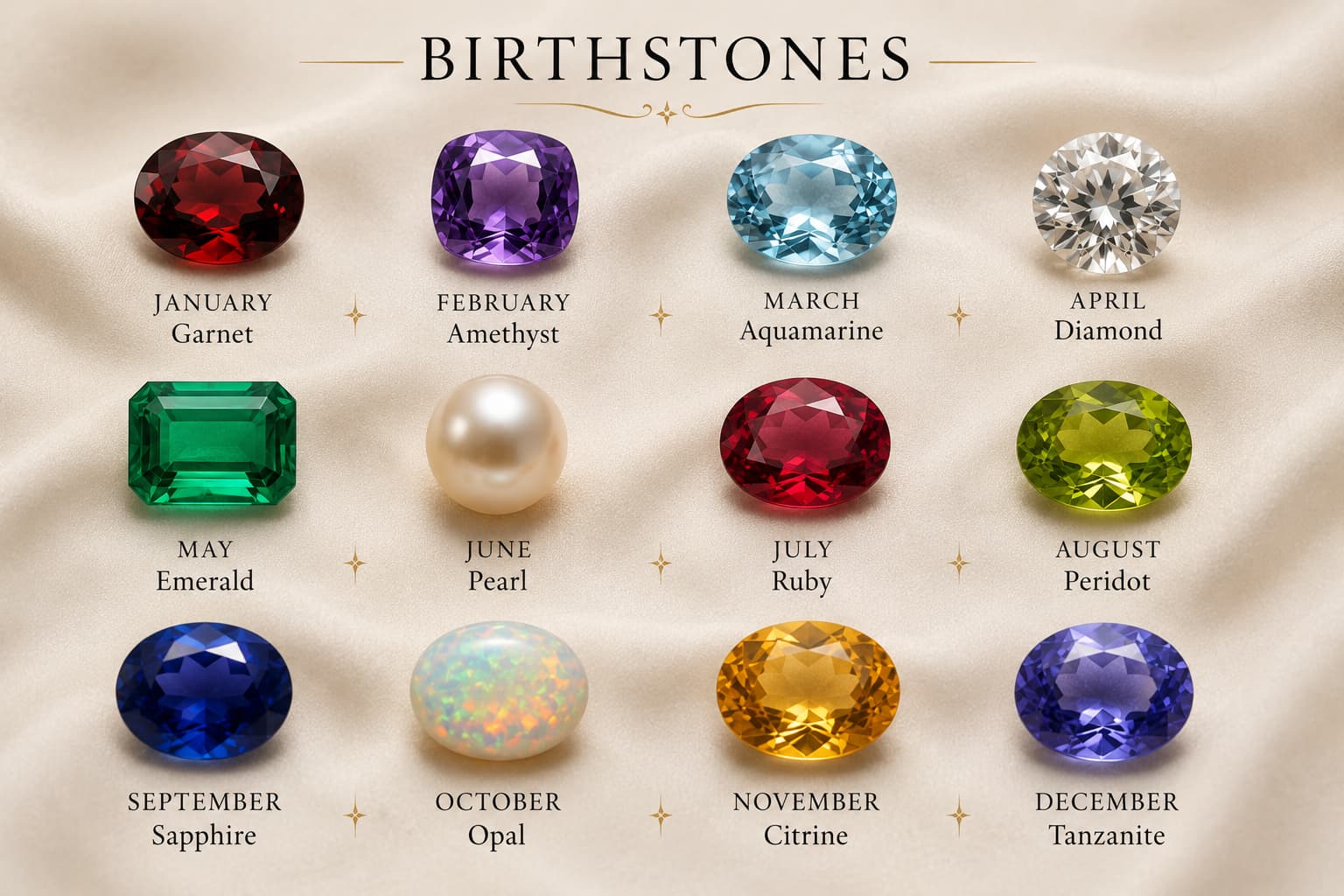
That 1912 list is essentially the backbone of the modern birthstone chart still used today. It has been adjusted a handful of times since then rather than being thrown out and replaced:
- 1952: Alexandrite was added for June, citrine was added for November, pink tourmaline was specified for October, and zircon was added as an option for December.
- 2002: Tanzanite was added as an additional December birthstone by the American Gem Trade Association.
- 2016: Spinel was added alongside peridot as a second option for August.
So when a stone is described as someone’s “modern” birthstone, it reflects decisions made by a 20th-century American trade organization, not anything handed down from antiquity.
It’s worth being honest about why the meeting happened at all. Some historians studying the list have described it less as a rediscovery of ancient wisdom and more as a straightforward act of retail salesmanship, an industry deciding that a clear, agreed-upon list would simply be easier to sell than a dozen competing folk traditions. That doesn’t make birthstones fake or meaningless, but it does explain why the modern list favors gems that were practical and profitable for jewelers in 1912, rather than the more obscure or opaque stones found on older traditional lists.
Modern Birthstones vs. Traditional Birthstones
The birthstone list used most often today is the “modern” list from 1912 and its later updates, while the “traditional” list refers to older stones tied to the 16th-to-18th-century European custom. The two lists overlap for several months but disagree for others, which is why some months have more than one accepted birthstone.
| Month | Modern Birthstone(s) | Traditional Birthstone |
|---|---|---|
| January | Garnet | Garnet |
| February | Amethyst | Amethyst |
| March | Aquamarine, Bloodstone | Bloodstone |
| April | Diamond | Diamond |
| May | Emerald | Emerald |
| June | Pearl, Alexandrite, Moonstone | Pearl |
| July | Ruby | Ruby |
| August | Peridot, Spinel | Sardonyx |
| September | Sapphire | Sapphire |
| October | Opal, Tourmaline | Opal |
| November | Topaz, Citrine | Topaz |
| December | Turquoise, Tanzanite, Zircon | Turquoise |
One reason the 1912 list favored transparent, faceted gems over cloudier or opaque ones like turquoise and sardonyx was practical: transparent stones were easier for jewelers to set into popular pieces like mother’s rings, which combine several family members’ birthstones side by side.
Do Other Cultures Have Their Own Birthstone Traditions?
Birthstones are not a uniquely Western idea, and several cultures developed their own gem-and-month or gem-and-planet systems independently. In Hindu Vedic astrology, for example, a system called navaratna centers on nine gemstones linked to celestial bodies rather than calendar months, with ruby or red spinel typically placed at the center and surrounded by the other eight stones.
Britain also went its own way. The National Association of Goldsmiths in the United Kingdom created its own official birthstone list in the 1930s, and while it shares several stones with the American list, it is not identical to it. That explains the small differences that show up between British and American jewelry guides, even though both are describing “official” birthstone lists.
Frequently Asked Questions
Are birthstones based on real ancient history or were they invented recently?
They are a mix of both. The number twelve and the general idea trace back thousands of years to a biblical breastplate, but the specific stone-to-month pairings most people use today were only formally standardized in 1912.
Why do some months have more than one birthstone?
Some months have both a modern and a traditional stone, and in a few cases the modern list itself offers more than one option, such as June’s pearl, alexandrite, and moonstone. This happened because trade groups added new stones over the decades rather than replacing the older ones outright.
Is there an official birthstone for every month worldwide?
Not exactly. The most widely used list in the United States comes from Jewelers of America, but Britain and other countries have developed their own separate lists, so the “official” stone for a given month can vary depending on which country’s tradition is being followed.
Who decided which stone goes with which month?
The current U.S. list traces back to the National Association of Jewelers meeting in 1912, with later additions made by groups like the Jewelry Industry Council of America and the American Gem Trade Association in 1952, 2002, and 2016.
Did people always wear just their own birthstone?
No. For a long time, the custom was to own and rotate through all twelve stones across the year rather than wearing only the one matching a person’s birth month. Wearing a single, personal birthstone only became common starting in Central Europe between the 16th and 18th centuries.
Conclusion
Birthstones carry far more history than their gift-shop reputation suggests, but that history is a lot less mystical and a lot more human than most people assume. What started as a sacred, twelve-stone breastplate slowly turned into a European custom of wearing a personal gem, and it wasn’t fully organized into the chart we recognize today until American jewelers standardized it in 1912. Knowing that timeline doesn’t make a birthstone any less meaningful, it just means the meaning was built gradually, by real people making real decisions, rather than appearing fully formed in the ancient world.